

Beethoven goes brain research
Violinist Dr. Stella Chen and pianist Dr. Mei Rui delivered a breathtaking performance of his “Kreutzer”.

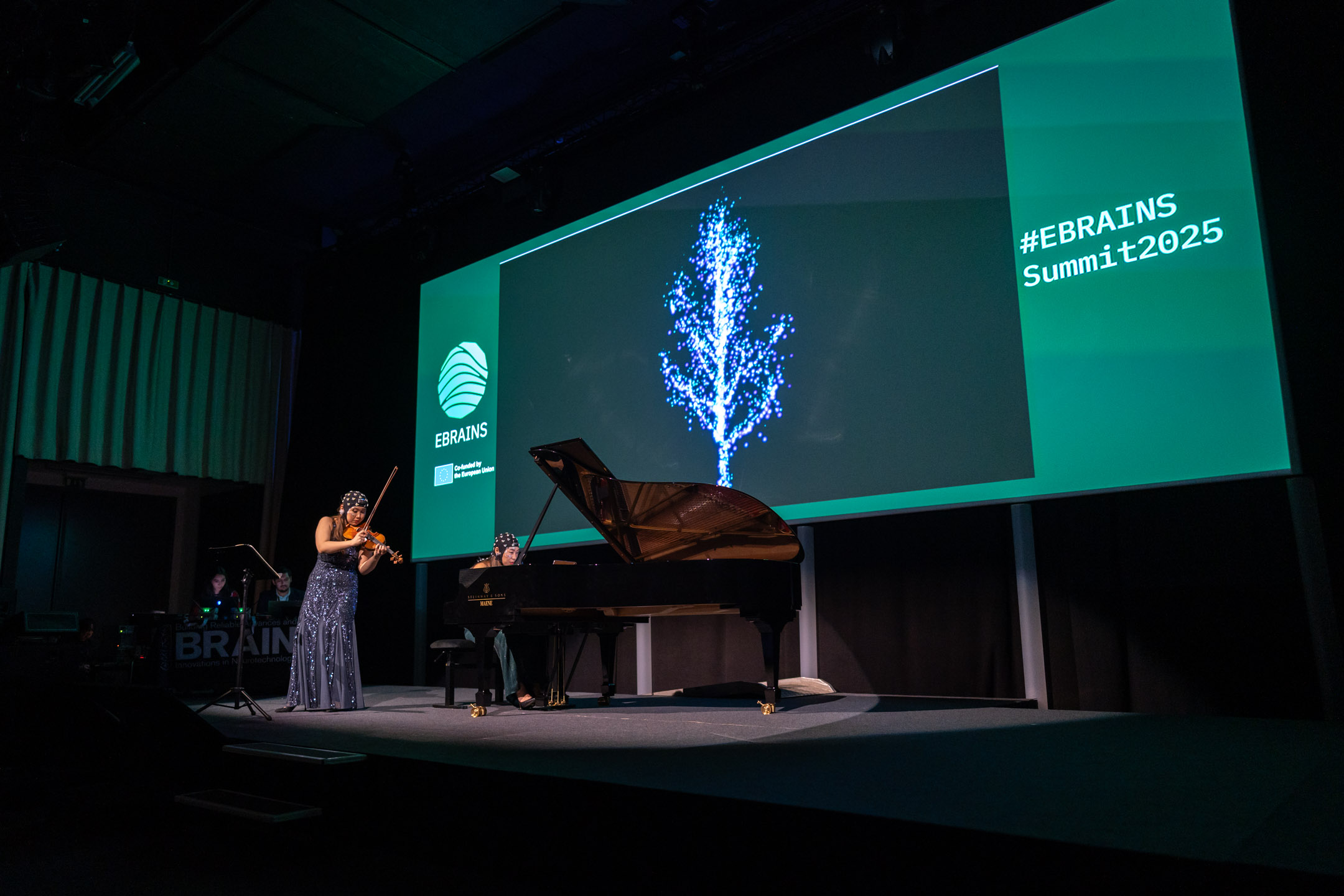
At the EBRAINS Summit 2025, violinist Dr. Stella Chen and pianist Dr. Mei Rui delivered a breathtaking performance of his “Kreutzer” Sonata during the session: Your Brain on Beethoven - Artistic performance by AccelNet where classical music mastery was merged with neuroscience and visual art.
As they performed, real-time Brain-Computer Interface visualisations - developed and recorded by AccelNet - displayed on screen representations of their neural activity. Scalp EEG, eye-tracking and synchronised hardware revealed shifts in alpha, gamma and delta waves across the sonata’s dramatic, meditative and galloping movements.
The experiment supported by an explanatory Q&A part showcased how elite musicians enter flow states, synchronise their brains and adapt to acoustic and emotional environments.
Artist-designed visuals made visible the synchronisation of the musicians neural dynamics of performance, transforming complex neural signals into an immersive show for the audience: a floating, shimmering interplay of signals.
Beyond the stage, the initiative feeds into the Music-in-Medicine programme, exploring how sound influences stress biomarkers and clinical performance. Ultimately, Dr. Mei Rui highlighted a long-term goal of developing personalised music profiles in healthcare, recognising acoustics as a powerful tool to affect brain activity and reduce stress.