

EBRAINS Summit Day 3 recap: From user science to future technologies
Community, emerging technologies and the future direction of European brain research

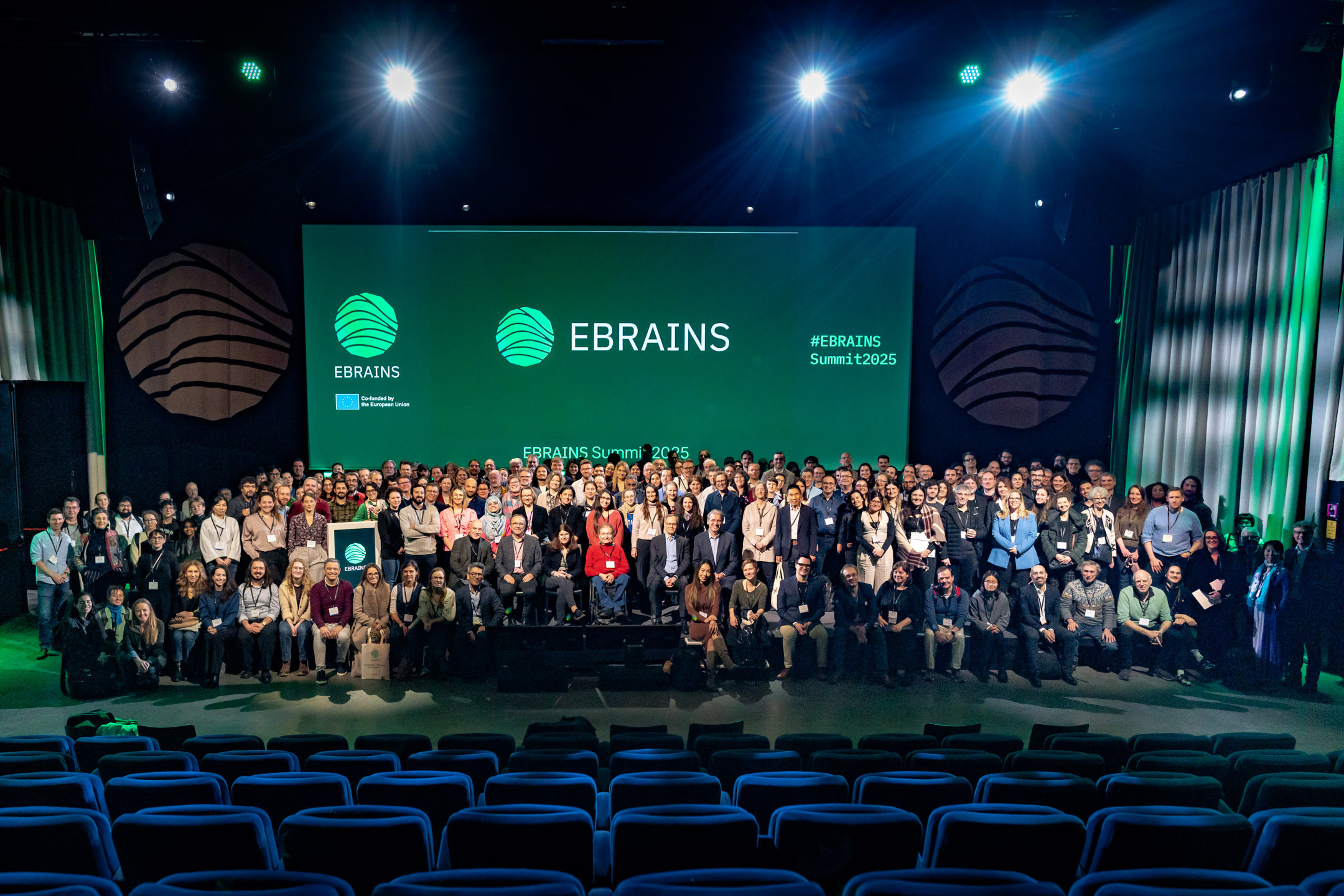
The third day of the EBRAINS Summit placed the spotlight on the community, emerging technologies and the future direction of European brain research – moving from user-driven science to visionary discussions on computing, neurotechnology and AI.
User Talks

The day opened with User Talks, a series of seven presentations from researchers actively using the EBRAINS infrastructure in their work. Together, the talks highlighted the diversity of scientific questions being addressed with EBRAINS tools, and how the platform is enabling reproducible, large-scale neuroscience across disciplines.
EBRAINS Roadmap 2026-2036
On behalf of the EBRAINS Management Board, Viktor Jirsa introduced the EBRAINS Roadmap 2026-2036 call – a community-driven initiative designed to help shape Europe’s neuroscience research agenda. Open to individual researchers and consortia across all fields of neuroscience, the call invites proposals until 1 March 2026, encouraging broad participation from the European and global research community.
Evolution of complex cognition

The keynote of the day was delivered by Onur Güntürkün, who explored “Converging Minds and the Evolution of Brains for Complex Cognition.” His lecture offered a comparative and evolutionary perspective on how complex cognitive functions emerge.
Future computing
Discussions on technology took centre stage during the session on Future Computing, which addressed both the opportunities and challenges of scaling neuroscience on Europe’s most powerful supercomputers. As EBRAINS computing services expand within the EuroHPC ecosystem, panellists emphasised the need for tackling energy consumption and sustainability.
Modelling and simulation
The programme continued with a session on Brain Modelling and Simulation. Fleur Zeldenrust (Donders Institute) opened the session encouraging researchers to get an EBRAINS account to find out what the infrastracture offers. She emphasised the wide variety of data across species, spatial scales and recording methods available on EBRAINS.
Neurotechnology
In the panel “Neurotechnology: Time for Europe?”, experts examined the accelerating pace of neurotechnological innovation, from next-generation imaging and stimulation techniques to molecular tools and implantable devices. The discussion focused on Europe’s opportunity to strengthen coordination and leadership in a field where the main bottleneck remains the real-time interrogation and manipulation of neural circuits.
Poster awards
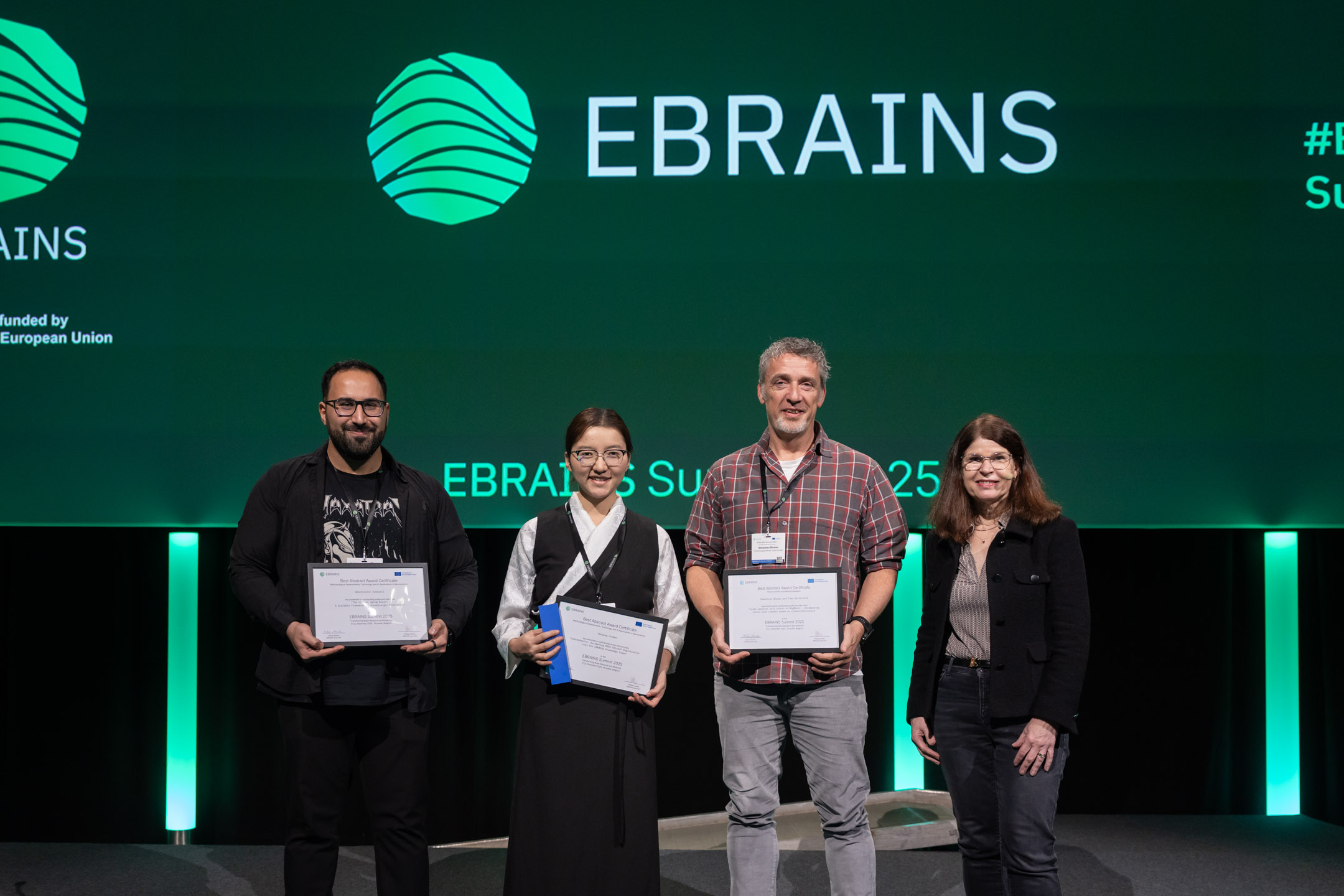
The day also celebrated excellence across the EBRAINS network with the Best Abstract Awards, recognising outstanding contributions in two categories. Awards were presented for Neuroscientific & Medical Resources and Technology & AI, highlighting work ranging from high-resolution brain mapping to innovative tools and models driving the future of computational neuroscience.
Sebastian Bludau and Timo Dickscheid received the award for Best Abstract for Neuroscientific and Medical Research. Two posters were awarded in the “Methodological developments, technology, and AI applications in neuroscience” category: Renqing Cuomao and Amirhossein Esmaeili.
Artificial Intelligence + Neuroscience
Two sessions focused on the relations between AI and neuroscience: At the “NeuroAI, Circuits, and Cognition”, speakers explored how The Virtual Brain (TVB) can evolve beyond its current initial applications, and how it opens new pathways toward simulating and understanding mental disorders such as Parkinson’s disease and schizophrenia. The “AI for Neuroscience and NeuroAI” session examined how neuroscience knowledge can inspire more realistic and powerful AI models.